Academic Biography
My academic career has been shaped by an interdisciplinary approach that bridges the humanities, archaeology, history, philosophy, and the study of ancient religions.
I began my higher education at Paris-Sorbonne University, where I completed a Licence (Bachelor’s degree) in Spanish and Latin American Literature. This early training in literary and cultural studies provided a strong foundation in critical analysis, languages, and the interpretation of texts. During this period, I also worked in the financial markets in Paris, gaining valuable professional experience before redirecting my career towards the humanities.
I subsequently undertook formal training in Fashion Design at the prestigious Chambre Syndicale de la Haute Couture (École Saint Roch) in Paris, where I studied for three years. My studies combined technical expertise with artistic and historical perspectives on design, leading to professional experience in several renowned Parisian haute couture houses. Although seemingly distinct from archaeology, this period fostered a lasting appreciation for material culture, craftsmanship, and the historical significance of artistic production.
My longstanding interest in the ancient world led me to pursue studies in Egyptology at the Institut Khéops in Paris, where I specialised in the ancient Egyptian language. This training introduced me to philological methods and the study of ancient textual traditions, providing an important methodological foundation for my subsequent archaeological research.
Following my move to London, I enrolled at the University of London, where I completed a Bachelor of Arts in History and Archaeology, specialising in the ancient Greek and Roman worlds. My undergraduate studies focused on Classical civilisation, Roman archaeology, ancient history, archaeological methodology, and the archaeology of the Mediterranean. I subsequently remained at the University of London to complete a Master of Arts in the History of Ideas, examining the intellectual, philosophical, and religious traditions that shaped the ancient and medieval Mediterranean world.
In 2014, I was awarded a Doctor of Philosophy (PhD) in Roman Archaeology by the University of Newcastle. My doctoral research examined the archaeological landscape of Baalbek-Heliopolis and its hinterland in modern Lebanon. The project investigated the transformation of one of the Roman Empire’s most significant religious centres between 100 BC and AD 400, exploring the interaction between indigenous religious traditions, Roman imperial ideology, and the emergence of Christianity. Particular attention was given to the relationship between monumental architecture, sacred landscapes, settlement patterns, and religious identity within the broader context of Roman provincial archaeology.
I subsequently expanded my research to encompass the Roman colony of Berytus (Colonia Julia Augusta Felix Berytus) and its surrounding territory. All of my postdoctoral research was conducted in Berlin, where I further developed my work on the political, religious, and cultural dynamics of Roman Lebanon. My research focused on processes of urbanisation, Romanisation, colonial identity, and the transformation of religious landscapes across the eastern Mediterranean, integrating archaeological evidence, historical sources, epigraphy, and landscape archaeology to reconstruct the social and religious development of the Roman Near East.
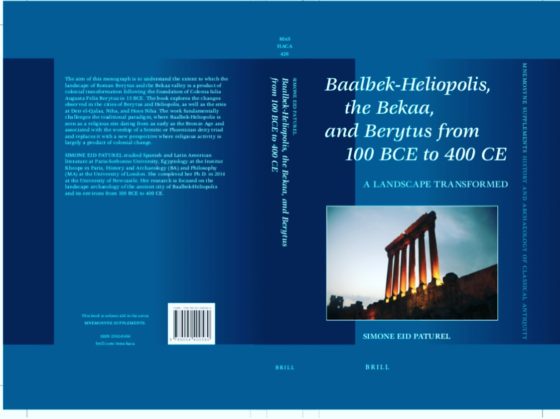
My publications include the monograph Landscapes of Conversion: Baalbek-Heliopolis, the Bekaa and Berytus from 100 BC to AD 400, as well as book chapters and scholarly articles on Roman archaeology, religious transformation, and the archaeology of Roman Lebanon.
My broader research interests include Roman archaeology, landscape archaeology, sacred landscapes, religious transformation in Late Antiquity, Roman provincial studies, the archaeology of Lebanon and the Near East, cultural identity, and the relationship between archaeology, history, and historical memory. I have a particular interest in interdisciplinary methodologies that integrate archaeological evidence, historical sources, epigraphy, spatial analysis, and digital approaches to reconstruct the social, cultural, and religious development of ancient communities.
I am fluent in French, English, and Lebanese Arabic. I also possess a good reading knowledge of Spanish, a good understanding of German, and have studied ancient Egyptian, enabling me to consult primary and secondary scholarly literature across several linguistic traditions.
